
Research based on latest news:
The sources directly support and expand on a growing concern in education: the rapid deployment of AI tools is outpacing the development of AI literacy. As a result, many educators and students still approach Large Language Models (LLMs) like ChatGPT with a “Google mindset”—type a query, skim the first answer, and move on.
The Problem: AI Literacy Gaps and the Google Mindset
Several patterns emerge across the literature:
- A literacy problem, not just a technology problem. Treating an LLM as if it were a simple search engine is identified as a core literacy gap. Users do not yet understand how these systems generate text, what they are good at, or where they fail.
- Gaps in knowledge among students and faculty. Studies consistently report limited understanding of how to use generative AI tools appropriately in academic work, including weak awareness of issues like hallucination, bias, and integrity.
- The legacy of the Google mindset. For more than two decades, the public has been trained to enter a short query, click a link, and accept the result. When this mindset is applied to an LLM, the real learning—which happens in the back-and-forth conversation—is bypassed.
In this context, new AI tools do not automatically lead to better learning. They can just as easily replicate old habits at higher speed.
Why New Tools Alone Are Not a Fix
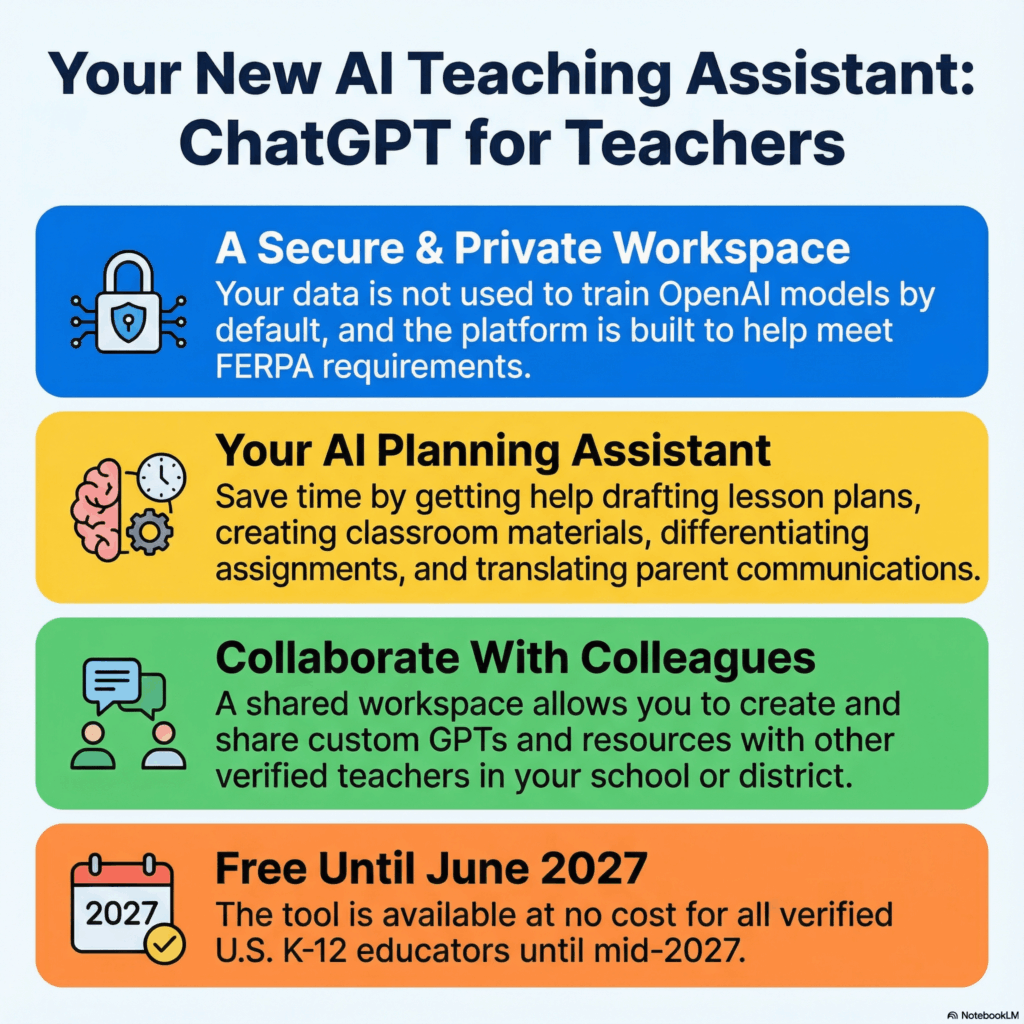
The launch of tools like ChatGPT for Teachers—a free, secure workspace for verified U.S. K–12 educators through June 2027—helps address technical and policy needs such as privacy, access, and efficiency. But the sources show that infrastructure is not the same as pedagogy.
Three concerns show up repeatedly:
- Solving the wrong problem. At least one critic describes ChatGPT for Teachers as a “disappointing model” that risks baking in discredited theories and pedagogically weak approaches. The platform is highly optimized for generating materials but less clear about how to support deep learning or AI literacy.
- Overemphasis on utility. Competing ed-tech leaders argue that the emphasis is on productivity and convenience (faster lesson plans, auto-generated materials) rather than on outcomes like student understanding, critical thinking, or authorship.
- Risk of speeding up bad practice. Without a shift in mindset, AI may simply speed up poor assignments—allowing teachers to rapidly generate worksheets or superficial tasks without reconsidering what students are actually being asked to think, create, or argue.
In short, new AI tools can increase efficiency in the wrong dimension if educators are not also supported in changing how they design and evaluate learning.
The Needed Shift: From Truth Machine to Thinking Partner
The sources converge on a central claim: the real change required is not just new software, but a new mental model for AI in education.
Key literacy messages include:
- LLMs don’t think. An LLM does not understand truth; it predicts the next likely word based on patterns in its training data. It is a statistical pattern-matcher, not a mind.
- Not a truth machine. LLMs are powerful tools for producing drafts, options, and explanations, but they are not a source of guaranteed truth, have no moral compass, and cannot replace human ethical or disciplinary judgment.
- Questions are the scarce resource. In a world of infinite, instantly generated answers, the human skill that matters most is asking better questions. Learning happens not in the first output, but in the iterative conversation—asking “why,” “what’s missing,” and “what else might be true?”
This is the mindset shift: away from “ask once and accept” toward conversational, critical engagement with the model.
The Prompt–Probe–Prove (PPP) Framework
To operationalize this shift, the sources describe a simple but powerful three-step loop: Prompt, Probe, Prove.
| Step | Action | Literacy Goal |
|---|---|---|
| Prompt | Ask the model for something; clearly frame the task, constraints, and context. | Develop purposeful prompt design aligned with learning goals and success criteria. |
| Probe | Interrogate the answer; question it, compare it, and ask the model to explain or revise. | Build critical discernment and position the human as the judge of quality and alignment. |
| Prove | Do something human with the output—synthesize, critique, apply, or extend it as new work. | Recenters human judgment, creativity, and disciplinary standards as the basis for evaluation. |
Instead of treating AI as an invisible ghostwriter, PPP makes the human–AI interaction itself a core site of learning. Produced from early research by Kori Ashton.
Making Learning Visible: Using Transcripts
One practical implication is to redesign assignments so they assess process as well as product. Rather than only collecting a polished final essay or project, instructors can require students to submit:
- A slice of their conversation transcript with the AI,
- Their prompts, and
- Annotations explaining what they rejected, changed, or challenged—and why.
This approach:
- Forces students to wrestle with the AI, not just accept its first output.
- Makes their reasoning, skepticism, and revisions visible for feedback.
- Helps instructors evaluate not only what students wrote, but how they used AI as a tool.
Conclusion: Systems, Tools, and Leadership
Donella Meadows reminds us that real leverage in a system comes from changing its goals, rules, and information flows, not just adding new tools. Simply introducing “ChatGPT for Teachers” into classrooms without a parallel shift in AI literacy risks reinforcing the Google mindset at scale.
Pairing new tools with frameworks like Prompt–Probe–Prove changes the goal: from rapid answer retrieval to critical discernment and thoughtful authorship. In that model, AI is not a shortcut around thinking but a structured partner in the learning process—and the teacher remains the leader who sets the goals, designs the rules, and helps students discover that they already know what to do with powerful new technologies.
References:
Ashton, K. (2025, November 22). A professor’s guide to teaching with AI: From search engine to thinking partner. Texans For AI.
Capoot, A. (2025, November 19). OpenAI rolls out ‘ChatGPT for Teachers’ for K-12 educators and districts. CNBC.
Chaudhry, I. S., Sarwary, S. A. M., El Refae, G. A., & Chabchoub, H. (2023). Time to Revisit Existing Student’s Performance Evaluation Approach in Higher Education Sector in a New Era of ChatGPT — A Case Study. Cogent Education, 10(1), 2210461. https://doi.org/10.1080/2331186X.2023.2210461.
Fox, D. (2025, November 21). Is this the future of teaching? FCPS becomes one of the first districts to test OpenAI’s “ChatGPT for Teachers” tool.
Guan, Q., & Han, Y. (2025). From AI to authorship: Exploring the use of LLM detection tools for calling on “originality” of students in academic environments. Innovations in Education and Teaching International, 62(5), 1514–1528. https://doi.org/10.1080/14703297.2025.2511062.
Hendrick, C. (2025, November 24). Why ChatGPT for Teachers might make things worse.
Kelly, R. (2025, November 19). OpenAI unveils ChatGPT for Teachers. THE Journal.
Langreo, L. (2025, November 21). ChatGPT for Teachers: A boon, a bust, or just ‘meh’? Education Week.
Meadows, D. H. (n.d.). The question of leadership: A good leader sets the right goals, gets things moving, and helps us discover that we already know what to do. The Academy for Systems Change. Retrieved from https://donellameadows.org/archives/the-question-of-leadership-a-good-leader-sets-the-right-goals-gets-things-moving-and-helps-us-discover-that-we-already-know-what-to-do/.
Meadows, D. H. (2008). Thinking in systems: A primer (Nachdr.). Chelsea Green Pub..
NBC Palm Springs. (2025, November 23). OpenAI launches new ChatGPT tool designed specifically for K–12 teachers.
News Staff. (2025, November 19). OpenAI offers free access to ChatGPT for U.S. K-12 teachers. GovTech.
OpenAI. (n.d.). ChatGPT for K–12 teachers.
Ortiz, S. (2025, November 19). ChatGPT for Teachers rolls out, and it’s free – here’s what makes it different. ZDNET.
Revell, T., Yeadon, W., Cahilly-Bretzin, G., Clarke, I., Manning, G., Jones, J., Mulley, C., Pascual, R. J., Bradley, N., Thomas, D., & Leneghan, F. (2024). ChatGPT versus human essayists: An exploration of the impact of artificial intelligence for authorship and academic integrity in the humanities. International Journal for Educational Integrity, 20(1), 18. https://doi.org/10.1007/s40979-024-00161-8.
Rivero, V. (2025, November 19). OpenAI’s ChatGPT for Teachers marks major K–12 AI milestone. EdTech Digest.
Sharma, R. C., & Panja, S. K. (2025). Addressing Academic Dishonesty in Higher Education: A Systematic Review of Generative AI’s Impact. Open Praxis, 17(2). https://doi.org/10.55982/openpraxis.17.2.820.
Singh, R. G., & Ngai, C. S. B. (2024). Top-ranked U.S. and U.K.’s universities’ first responses to GenAI: Key themes, emotions, and pedagogical implications for teaching and learning. Discover Education, 3(1), 115. https://doi.org/10.1007/s44217-024-00211-w.