Across social media, a familiar pattern is emerging from teachers: as soon as generative AI shows up in student writing, many instructors move everything “back to pen and paper.” Homework becomes in-class writing. Laptops are shut. Essays are handwritten.
News coverage is starting to document this shift: as AI tools like ChatGPT spread, teachers increasingly restrict take-home writing and lean on in-class exams to protect originality. (AP News)
At first glance, this looks like a simple rule about technology use. But if you listen closely to how faculty talk about it—like in this LinkedIn thread around Ashley Kovacs’ AI rubric —it’s really about something deeper:
- fear that authorship can’t be verified,
- a desire to see thinking, not just polished text,
- and an intuition that students can’t use AI well without solid foundations in the subject.
Those are legitimate concerns. The risk is that “back to pen and paper” becomes a nostalgic answer to a very current problem.
The real question isn’t whether students should struggle. It’s where and how we locate that struggle in an AI-saturated world.
Our Glory Days of Struggle… and Theirs
For many of today’s faculty, our deepest learning memories are analog:
- handwriting pages of proofs or drafts,
- wrestling with index cards and library stacks,
- typing and re-typing papers without spell-check (and liquid paper – ugh! the struggle was real),
- doing the hard thing with pen, paper, and a quiet room.
We learned to equate that specific kind of discomfort with “real learning.” So when AI makes writing easier—or at least seem easier—it feels as if the struggle (and therefore the learning) has vanished.
But for this and the next generation of students, the default medium is different. Their “paper” is a shared doc, a notes app, or a chat window. Their background environment is:
- instant information with a click,
- infinite text on demand,
- autocomplete everywhere,
- and now large language models that will happily write a first pass at almost anything.
If we insist that the only “authentic” struggle is our version—blue books, timed essays, handwritten drafts—we risk confusing nostalgia with pedagogy.
The better question is:
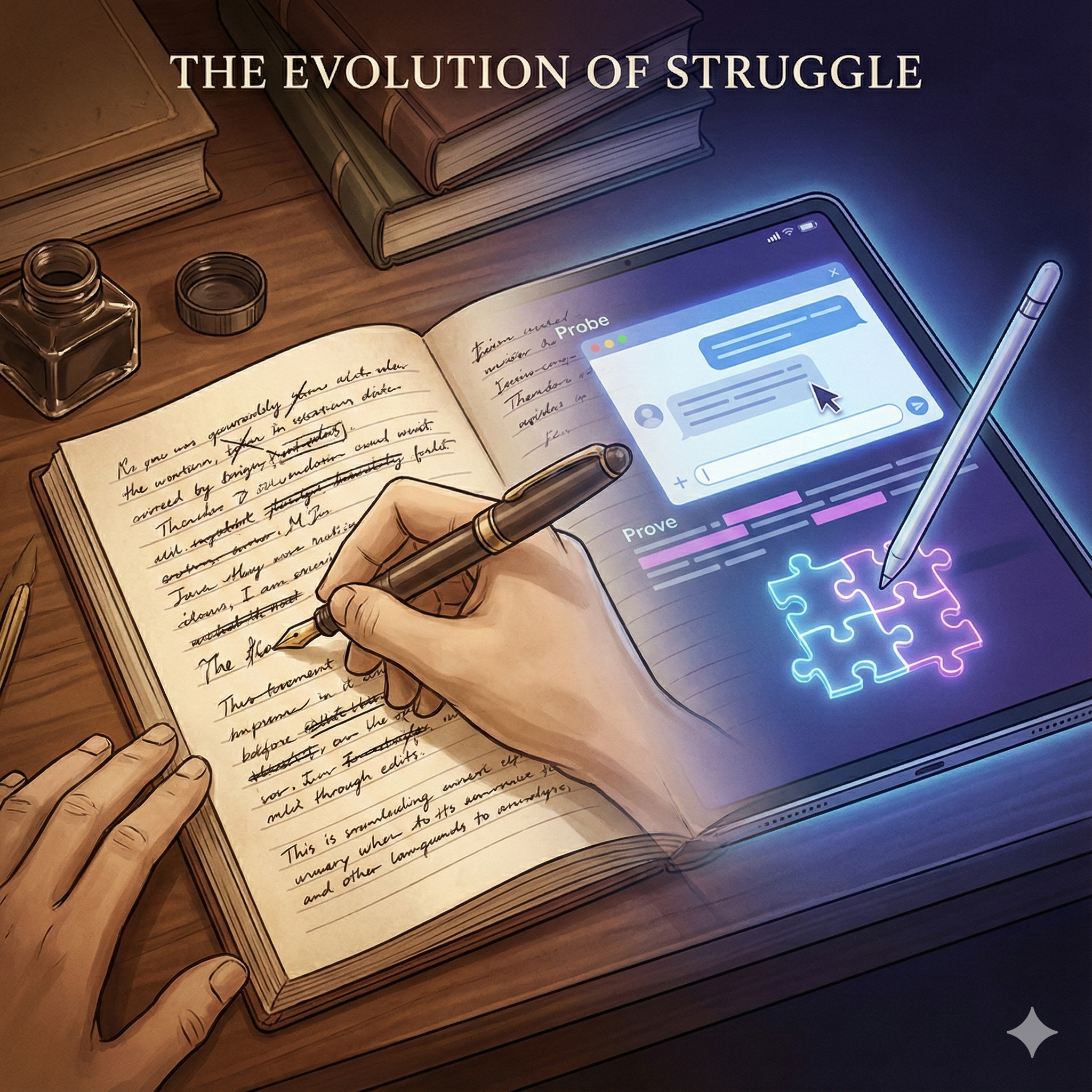
What is their version of pen to paper? Where does their productive struggle naturally live?
For many of them, the hardest thing is not getting words on a page. It’s:
- knowing what to ask the model,
- recognizing when the answer is shallow or wrong,
- and taking ownership of the final claim in their own voice.
That’s exactly the space where the Prompt–Probe–Prove framework is trying to occupy.
What “Back to Pen and Paper” Is Really Asking For
If we strip away the nostalgia, the move back to paper is really asking for three things.
1. Evidence of genuine understanding
Studies of ChatGPT use in higher education keep landing on the same tension: generative AI can improve learning when it’s used to scaffold understanding, but it can also encourage shallow processing when students just copy outputs.(nature.com)
Faculty feel this viscerally. They want to see that students can explain, connect, and extend ideas—not just generate grammatically correct paragraphs.
2. Confidence about authorship and integrity
Researchers and policy bodies are documenting widespread concern that text from ChatGPT blurs the line between assistance and plagiarism.(ScienceDirect)
At the same time, AI detectors are unreliable and sometimes biased—especially against multilingual writers and other marginalized groups—making it risky to accuse students based purely on detection scores.(Brandeis University)
When you can’t prove AI use and you don’t quite trust the text in front of you, pen-and-paper exams feel like the only safe option.
3. Assessments that can’t be easily automated
Recent work on assessment design in the GenAI era argues that many traditional tasks (short essays, basic case analyses, summaries) can now be completed by generative models “with limited effort and knowledge.”(arXiv)
Design groups at UBC, UNSW, and other universities are therefore encouraging a shift toward multi-stage, contextual, and applied assessments rather than doubling down on surveillance and bans.(AI in Teaching and Learning)
So again, the instinct is understandable. But it’s a design problem, not a stationery problem.
Foundational Knowledge Is Still the Keystone
There’s another thread in that LinkedIn conversation that surfaced: several educators insist that students need a solid foundation before using AI.
Empirical work with ChatGPT supports this nuance:
- In a semester-long action-research project at Universidad Camilo José Cela (Spain), 108 students and 24 professors worked with an AI-enhanced curriculum where tasks always paired “AI generation/search” with human analysis, reflection, and editing. The authors explicitly describe this dual model as validating GenAI as cognitive scaffolding rather than a replacement for student agency, and report gains in critical reasoning, ethical reflection, and self-regulation on pre/post measures.
- At the same time, case studies and discourse analyses warn that over-reliance on GenAI can blunt independent thinking and originality. The India case study in the IIE–WISE report notes that students’ extensive use of AI for assignments and exam prep brought productivity gains but raised concerns that it “may impede the development of critical thinking, independent problem-solving, and originality.” A complementary review of top-ranked U.S. and U.K. universities’ first responses to ChatGPT reports faculty fears that AI-generated text may “impair students’ writing, critical thinking, and creativity,” reinforcing worries about academic integrity and long-term cognitive effects.
In other words: AI amplifies whatever cognitive habits and knowledge structures students already bring.
If they have a mental model of the topic, AI can help them refine, extend, and test it. If they don’t, AI mostly helps them assemble plausible text without real understanding.
So yes: foundational knowledge is non-negotiable. But we don’t have to build it outside the AI environment. We can build it through how we structure Prompt–Probe–Prove.
Prompt–Probe–Prove as Their New “Pen to Paper”
If pen and paper were our generation’s arena of struggle, the 3-Step Framework of Prompt–Probe–Prove can be theirs.
Here’s one way to frame it explicitly for faculty.
1. Prompt: Where students start with the tool
We let students use GenAI to:
- brainstorm research questions,
- draft outlines,
- generate competing explanations or examples,
- translate or clarify dense readings.
The key here is transparency and documentation: students save their prompts and outputs as part of the assignment bundle.
This is not where the grade lives. This is where the raw material appears.
2. Probe: Where the productive struggle happens
Probe is where we deliberately put the heavy lift:
- Critique: “Highlight three places where the model’s answer is incorrect, oversimplified, or unsupported. Fix them using course readings.”
- Compare: “Generate two different model responses; explain which one better aligns with [theory/author] and why.”
- Trace: “Identify which claims in the AI output you can link to credible sources, and which you cannot.”
This maps neatly onto emerging best practice in AI-era assessment, which recommends asking students to explain, justify, and interrogate AI outputs rather than simply forbidding them.(Teachers College Columbia University)
Probe is their version of staying up late over a messy draft. It’s where they learn to see gaps, contradictions, bias, and missing nuance—and start to feel the effort of thinking.
3. Prove: Where authorship is reclaimed
Prove is the part that must unmistakably belong to the student:
- a short oral defense (“Talk me through how you got from the AI draft to this final argument”),
- a reflection that connects the work to prior learning or lived experience,
- or a final product that weaves course readings, data, and their own stance into a coherent position.
Here, generative AI can’t do the work for them without leaving fingerprints: it doesn’t know their past writing, their local context, or their inner reasons unless they bring those to the page.
This is also where concerns about authorship and integrity are best addressed. Instead of trying to catch AI after the fact, we ask students to perform their authorship in public—in writing, in voice, or both.
Design Moves That Move the Struggle (Without Moving Backwards)
Putting this together, a few practical shifts emerge.
1. Make AI use allowed—but incomplete
Signal clearly that AI can be used for Prompt, but the graded components sit in Probe and Prove:
- Require submission of prompts and raw outputs.
- Grade the analysis, not the first draft.
- Treat unexplained, un-probed AI output as an incomplete assignment, not a clever shortcut.
This aligns with recent guidance that encourages explicit “AI use statements” on syllabi and assignments, so students understand what forms of collaboration with GenAI are legitimate.(Teaching Gateway)
2. Pair written work with short viva-style checks
Instead of moving everything to handwritten exams, add a 5–10 minute check-in:
- “Explain this paragraph in your own words.”
- “If you had one more week, what would you change?”
- “What did the AI get wrong in your first draft?”
This is low-tech but highly aligned with studies showing that AI is most beneficial when learners engage actively and reflectively rather than passively consuming outputs.(nature.com)
3. Design assignments AI can’t finish alone
Drawing on emerging assessment frameworks, we can intentionally design tasks that require:(ERIC)
- local data (campus, community, workplace),
- personal or professional experience,
- iterative revision over time (peer review, drafts, self-assessment),
- or cross-modal output (text plus presentation, interview, or prototype).
Generative AI can still be a tool inside these processes, but it’s no longer the whole game.
Don’t Go Back. Move the Struggle.
The “back to pen and paper” impulse is understandable. It’s trying to protect:
- real learning,
- real authorship,
- and real trust between students and faculty.
But pen and paper were never the point. The point was the struggle we went through while using them.
For this generation and likely those to come, that struggle won’t always happen in blue books with a #2 pencil. It will happen in messy prompt histories, in half-useful AI drafts, in the discomfort of critiquing a system that seems smarter than you, and in the quiet moment where a student finally says:
“Okay, this sentence is mine. I can defend this.”
Prompt–Probe–Prove gives us a way to design for that kind of learning on purpose.
So instead of asking, “How do we get them away from the tools?” we can start asking:
- Where do we want them to feel the struggle?
- How can we make Probe and Prove unavoidable, visible, and supported?
- And how do we help them build the kind of foundational knowledge that lets AI become a sparring partner, not a ghostwriter?
We don’t need to go back.
We need to move the struggle to where their “pens” actually are.