
Computers were people.
Since ChatGPT launched on November 30, 2022, job-loss anxiety has surged—but this fear isn’t new. Nearly eight decades ago, NASA faced its own “automation moment,” back when the word computer didn’t mean a machine. It meant a person.
And one of the clearest leaders through that technology shift was Dorothy Vaughan, made widely known through the film Hidden Figures. The movie’s Dorothy is the woman who refuses to be intimidated by the new technology, learns it anyway, and (spoiler alert) then helps her team survive the transition.
That part of the story—technology disruption and workforce reinvention—is exactly the conversation we need right now with AI.
The real Dorothy Vaughan: leadership in a segregated system
Dorothy Vaughan worked at Langley (then NACA, later NASA) during an era of Jim Crow segregation. She led the West Area Computing Unit—an all-Black group of women mathematicians who were required to work separately and use segregated facilities. (NASA)
In 1949, Vaughan was promoted to lead that unit, becoming NACA’s first Black supervisor and one of its few female supervisors. (NASA)

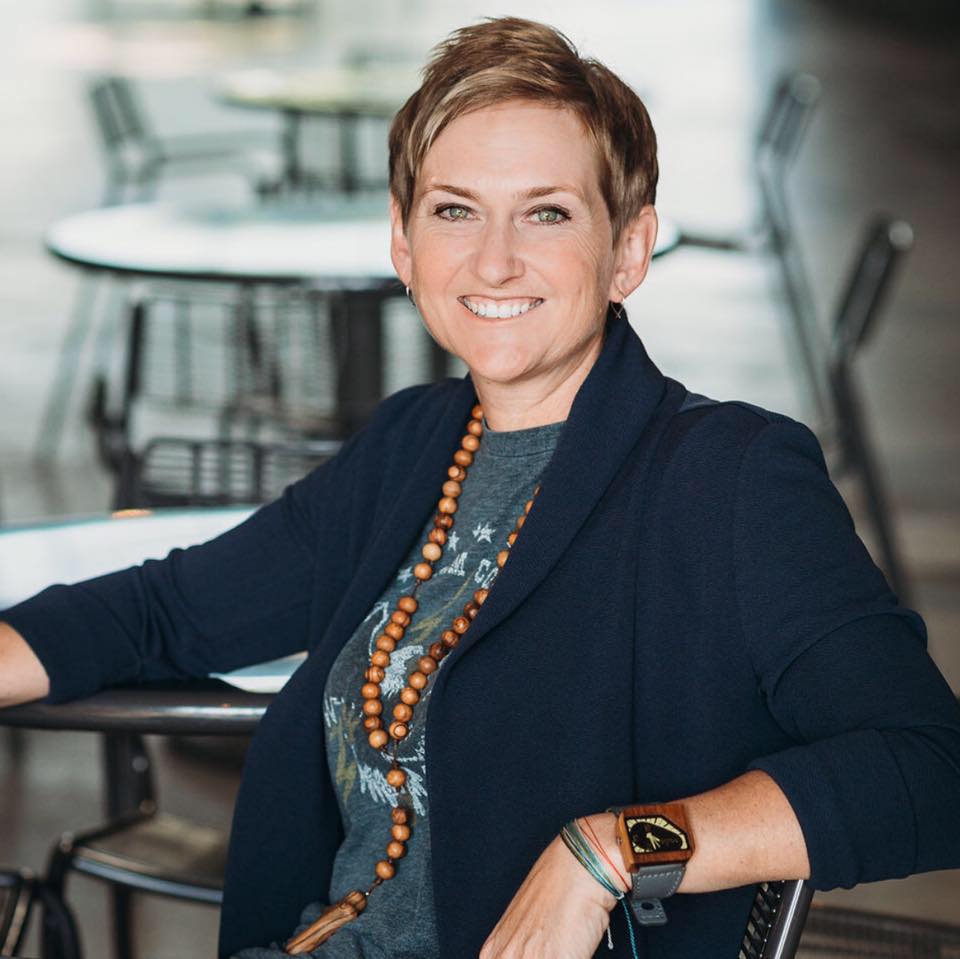
AI-Generated Likeness of Dorothy Vaughn – Nano Banana Pro
And her leadership wasn’t just title-deep. NASA’s own biography describes her as a steady advocate for her people, with engineers often requesting her specifically for challenging assignments. (NASA)
Then the disruption hit: electronic computers
The West Area Computers were doing high-stakes math by hand—reading data, running calculations, plotting results—work essential to research and flight. (NASA)
But by the late 1950s, the organization changed:
- In 1958, as NACA transitioned to NASA, segregated facilities (including the West Computing office) were abolished. (NASA)
- The West Area Computing Unit itself was formally disbanded and the women were reassigned into integrated branches. (National Archives)
- Vaughan and many of the former West Computers moved into the new Analysis and Computation Division (ACD), a racially and gender-integrated group on the frontier of electronic computing. (NASA)
This is the part we can’t skip: the “new technology” didn’t show up in a neutral environment. It arrived inside a workplace shaped by racial and gender inequity. And still—Vaughan chose the path of preparedness.
NASA’s biography notes she became an expert FORTRAN programmer (a key programming language of that era) and contributed to NASA programs like the Scout Launch Vehicle Program. (NASA)
What Hidden Figures dramatizes—and why it still matters
In Hidden Figures, two of the most memorable moments include:
In the “Colored Cafeteria” scene, Dorothy tells her closest friends and co-workers:
“Somewhere down the line a human being’s going to have to hit the buttons.”
Another was Dorothy getting access to FORTRAN learning materials and teaching herself, then bringing that knowledge back to her team. Critically, the film frames her as someone who doesn’t just “save herself,” but helps others transition, too. (The New Yorker)
Is every scene literal history? Movies compress timelines and create composite moments.
But the leadership lesson is historically grounded: Vaughan prepared for the new era of computing and helped her people stay valuable during the shift. (NASA)
That’s the bridge to AI.
AI feels scary for the same reason the “electronic computer” felt scary
Most job fear isn’t really fear of technology.
It’s fear of:
- being made irrelevant
- losing income
- losing identity and confidence
- not knowing what to learn next
- watching change happen to you instead of with you
And yes—new technology often does replace tasks for efficiency. That’s not paranoid. That’s business – some may even say progress.
But history shows a pattern: technology rarely eliminates all work. It reorganizes work.
Which means the power move is not “ignore it” or “fight it.”
The power move is: become fluent enough to direct it.
The Dorothy Vaughan Playbook for the AI era
If you’re building a future-ready workforce (or trying to stay future-ready yourself), Dorothy’s story offers a simple playbook.
1) Don’t wait for permission to learn
Vaughan didn’t need a formal invitation to prepare for what was coming. She moved early.
AI translation: Don’t wait for your job description to change before you upskill. Start now—small, consistent reps beat panic-learning later.
2) Learn the “language,” not just the tool
Vaughan didn’t just “use a computer.” She became fluent in what made the computer useful: programming. (NASA)
AI translation: Don’t just collect AI apps. Build baseline fluency in:
- prompting + iterating
- quality control (checking outputs)
- workflow design (where AI fits, where it doesn’t)
- data/privacy basics (what should never be pasted into a model)
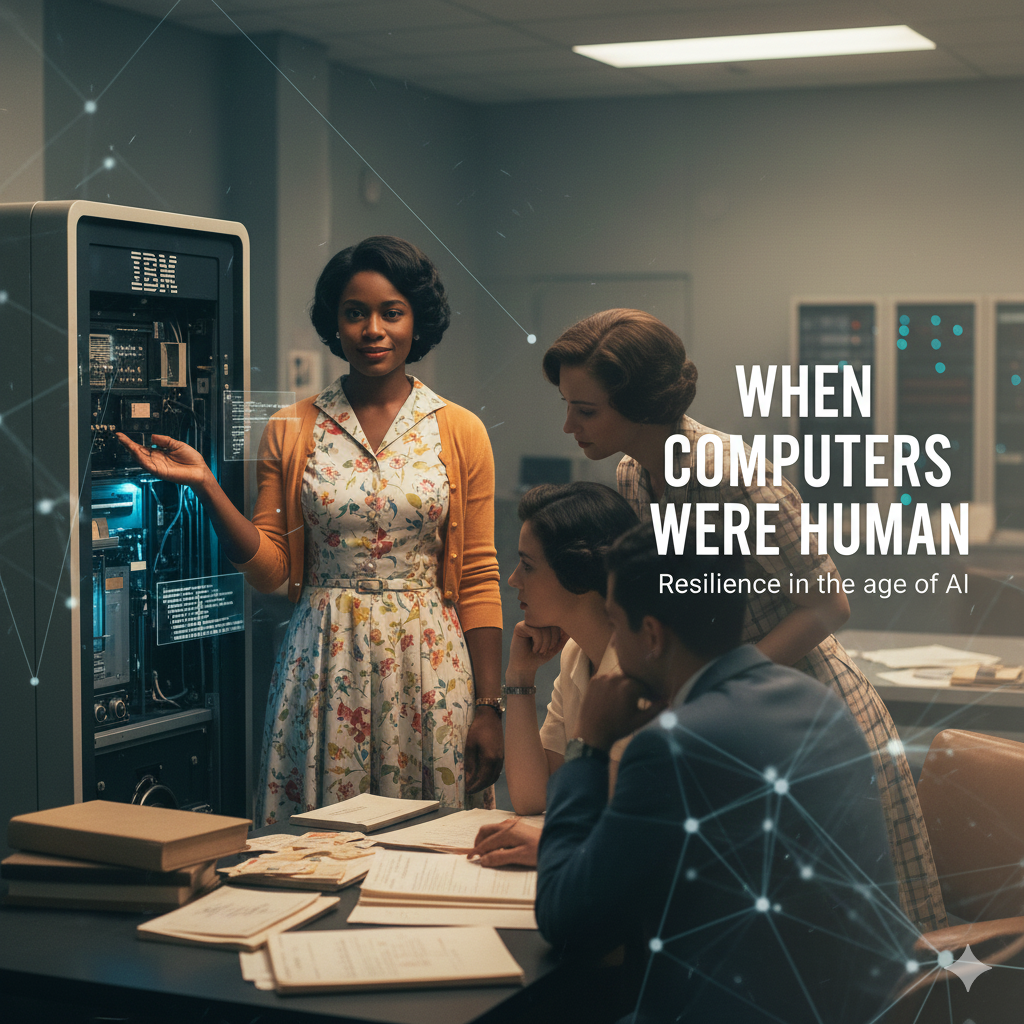
AI-Generated Image. Not Dorothy Vaughn.
3) Become the translator in the room
The most valuable person in a tech shift is often the one who can translate between:
- leadership goals
- real workflows
- technical capabilities
- human concerns
Vaughan had rare visibility across the lab and was trusted for recommendations. (NASA)
AI translation: You don’t have to be the “deepest” technical person to be essential. Be the person who can make AI usable, safe, and repeatable.
4) Lift your people, not just your resume
Dorothy’s legacy isn’t only what she learned—it’s that her leadership helped others build careers too. NASA notes her legacy lives on through the successful careers of other West Computing alumni. (NASA)
AI translation: The ethical win is team-wide resilience: shared templates, shared training, shared standards—not gatekeeping.
The ethical layer: “under the hood” power requires guardrails
AI is powerful, but “power” isn’t automatically good.
If we want AI to improve life and work, we have to build the habit of using it ethically and responsibly:
- Privacy: don’t input sensitive client/student/patient data unless you have explicit permission and compliant systems.
- Bias awareness: models can reproduce harmful patterns.
- Verification: AI can sound confident and still be wrong—especially with facts, numbers, or legal/medical info.
- Accountability: humans remain responsible for outcomes.
This is how we make sure AI becomes a tool for opportunity—not a machine that quietly amplifies inequity.
What Texans for AI can champion right now
Texas is full of builders—small business owners, educators, operators, creatives, and enterprise teams. That’s a huge advantage in an AI transition, because builders don’t just talk about change—they implement it.
Here are strong “community-level” moves Texans for AI can rally around:
- AI literacy for everyone: not “become a developer,” but “become competent.”
- Workforce transition pathways: help people map adjacent skills (what they already know → what AI changes → what to learn next).
- Ethical standards in practice: model policies, classroom guidelines, small business playbooks.
- Human-centered adoption: use AI to remove drudge work and increase access—not to hollow out dignity.
The takeaway: disruption is real—but so is leadership
Dorothy Vaughan didn’t pretend the new era was harmless.
She faced it with clarity.
And that’s the point for us:
AI is changing our work and world. Some tasks will disappear. Some roles will transform. Some people will be displaced.
But we still have a choice in how we respond:
- intimidated… or curious
- reactive… or ready
- isolated… or building resilience together
Dorothy Vaughan’s story—both the real history and the popular retelling—reminds us what it looks like to meet a technology shift with skill, courage, and responsibility. (NASA)
My Favorite Part of the whole movie?? – Click play 🙂
Connection to Texas
Though Dorothy Vaughan’s groundbreaking work was done at NASA’s Langley Research Center in Virginia, her legacy now reaches Texas too—NASA’s Johnson Space Center in Houston dedicated the “Dorothy Vaughan Center in Honor of the Women of Apollo” to recognize that enduring impact.